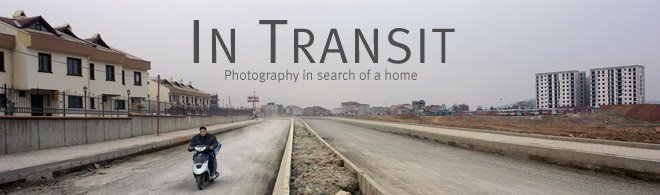
Here are a few images from the Shadow of the Bear project from my last trip to Georgia. The project is progressing really well. I think 1 more trip to Ukraine in September might well see the shooting part of the project completed.
Thursday, 29 July 2010
Invisible: London
A few random photos from the many I shot this summer for my London project.
Getting ready to go to Latvia to teach at the ISSP workshop during the whole of next week. Really looking forward to meeting both the other photographers teaching and the students. Usually I get a lot from these workshops, especially from the enthusiasm and energy of young photographers.
Friday, 16 July 2010
Exhibition images at CIAC Foligno, Italy
CII went to the opening last week of our joint exhibition at the CIAC Museum, in Foligno, Umbria.
I was really impressed with the museum, a contemporary rust covered cube from the outside and light, bright and spacious inside.
This is the first time someone has put Vanessa's and my Turkey work together. The dynamic between the two was interesting, adding an extra layer of meaning to the individual works.
For this I must thank Daniele Mattioli for inviting us both, Emanuele De Donno for doing a great job with the installation and Piter Foglietta, the organisor of Canti e Discanti.
I was really impressed with the museum, a contemporary rust covered cube from the outside and light, bright and spacious inside.
This is the first time someone has put Vanessa's and my Turkey work together. The dynamic between the two was interesting, adding an extra layer of meaning to the individual works.
For this I must thank Daniele Mattioli for inviting us both, Emanuele De Donno for doing a great job with the installation and Piter Foglietta, the organisor of Canti e Discanti.
Tuesday, 6 July 2010
Change of location
The Fault Lines exhibition on Foligno has change location. It will now be showing at the CIAC Museum alongside Vanessa's "Sweet Nothings". Opening is Thursday at 9pm and runs until the 9th September.
I will also be doing a presentation and book signing in an old Cinema in the town centre on Saturday at 12 noon.
A couple of curators have mentioned putting our work together but this is the first time it has happened.
Really looking forward to seeing how it holds together.
I will also be doing a presentation and book signing in an old Cinema in the town centre on Saturday at 12 noon.
A couple of curators have mentioned putting our work together but this is the first time it has happened.
Really looking forward to seeing how it holds together.
Monday, 5 July 2010
Ukraine: In the shadow of the bear
My agency in Italy, Prospekt, has uploaded some of my new work from Ukraine on their website.
I haven't got round to putting it on my site. It is very much a work in progress and is part of the larger "In the shadow of the Bear" project I am hoping to complete this year. See previous post
You can see the work HERE.
It's worth having a look around the Prospekt features.
I haven't got round to putting it on my site. It is very much a work in progress and is part of the larger "In the shadow of the Bear" project I am hoping to complete this year. See previous post
You can see the work HERE.
It's worth having a look around the Prospekt features.
Friday, 2 July 2010
Exhibition in Foligno, Umbria
Next week my Fault Lines /Turkey exhibition will be showing as part of the World music festival "Canti e discanti", in the beautiful Umbria town of Foligno. The festival includes music, film, photography and being Italy, FOOD. The exhibition will be held at the beautiful Corte di Palazzo Trinci, inside the arcaded inner courtyard. Opening 10th July at 11am.
Vanessa Winship will also be showing "Sweet Nothings" in CIac, Centro Italiano Arte Contemporanea,
A very interesting contemporary building, completely rusty on the outside and light and spacious on the inside. Opening 8th July 9.30pm
Vanessa Winship will also be showing "Sweet Nothings" in CIac, Centro Italiano Arte Contemporanea,
A very interesting contemporary building, completely rusty on the outside and light and spacious on the inside. Opening 8th July 9.30pm
Wednesday, 23 June 2010
BJP Project prize
A couple of months ago I was shortlisted for the BJP project award. Well, to my great delight, I have won the prize! Below is the article posted on the BJP website
“Up until today, I had to fund all my work entirely on my own, and any sales to magazines would only happen after. Now, I’m going to be able to go back to the Ukraine and Georgia and to have the money to do it.”
George Georgiou has spent the last decade travelling the Balkans, eastern Europe and Turkey after he and his partner, fellow photographer Vanessa Winship, sold their flat in London “to fund a great adventure”. Having based themselves in Belgrade, and later settling in Istanbul, shooting in-depth stories there and in neighbouring countries, they came back to London two years ago, but have continued shooting projects in the region on extended return visits.
Now Georgiou will go back to Georgia and the Ukraine with £5000 in his pocket – courtesy of the last-ever, Nikon-sponsored, Project Assistance Award – to complete his latest series there, In the Shadow of the Bear.
He was selected from a shortlist of eight photographers who were, along with more than 40 others, published in BJP over the last 15 months of our weekly editions. The eight – including Dana Popa, CJ Clarke, Clare Smart, Kalpesh Lathigra, Liz Hingley, Sayaka Maruyama and Jude Edgington – were given £300 to put together a detailed proposal as to what they would do with the bursary.
Katy Barron, an independent photography curator who acted as the contest’s judge, then read through the proposals and selected Georgiou. “In light of what he has done before, I can see that he will make a fascinating series,” she comments. “I like the way he linked the two countries. There is a lyrical pattern, which makes the whole more than the some of its parts. It has a personal, but also a universal appeal. I hope this award will push him to the next level in his career.”
In the Shadow of the Bear evolved from a very different idea, Georgiou tells BJP. “The original goal was to look at the eastern revolutions. Having already covered Serbia, I wanted to look at Georgia and Ukraine. I wanted to use these three countries to show the aftermath of the peaceful ‘colour’ revolutions.” But, after spending time in Ukraine, the photographer perceived the strong influence Russia still plays in these former Soviet regions. “Russia continues to interfere in their affairs, the same way the US did in Central America.”
In his project proposal, Georgiou writes that a “major geopolitical battle is still being fought out in Ukraine and Georgia, in their nascent stages of independence and nation-building and as they try to free themselves from Russian influence. Russia sees both countries as part of its sphere of influence, and as such acts like an imperial power towards its smaller neighbours.”
In the Shadow of the Bear will explore life after the Rose Revolution of 2003 in Georgia, and the 2004 Ukrainian Orange Revolution. “The work looks, in subtle and quiet moments, at the signs in the domestic and public spheres, which when taken together, build up a representation of how ordinary people in Georgia and Ukraine negotiate the everyday space that they find themselves in,” he says. “I am looking at each country individually, with their own very different dynamics and characteristics, but also the aspects that are familiar between the two through their shared history in the Soviet Union.”
Georgiou has already shot many pictures in the series, but says: “Now I have to fine-tune it. I need to look at the signs and symbols and at Russia’s presence. I am now at the more complex and reflective stage of producing the photographs and visual links that will bridge the two nations together in the shadow of Russia.”
Over the summer he plans to go back to both countries to explore the Black Sea coast and study the large residential districts around Kiev and Tbilisi. He expects to finish the work in September before taking on the longer task of editing and designing a monograph.
Georgiou will present his work at this year’s Vision, BJP’s annual event for early-career photographers, which takes place at the Business Design Centre on 19 November.
Saturday, 12 June 2010
Fault lines exhibition review
A review from Hotshoe blog
Review of George Georgiou’s exhibition Fault Lines at Side Gallery, Newcastle
June 10, 2010
© Katie Lin, photos from George Georgiou's exhibition Fault Lines at Side Gallery, NewcastleJune 10, 2010
You have until 17 July to catch George Georgiou’s impressive body of work Fault Lines: Turkey/ East / West now on show in the north of England. For those who are interested, the next issue of HotShoe International, June/July, features an interview I did with Georgiou while he was on the road overseeing the production of his debut book of the same title. In the interview, Georgiou talks about the development of the project and his working process.
In the post below, Newcastle University student Katie Lin reviews the show in words and pictures:
Far from the European country which has inspired his latest collection of photographs, George Georgiou’s Fault Lines: Turkey / East / West has found its way to England’s North-East and set up show at Newcastle’s Side Gallery for eight weeks.
The upper gallery houses a selection of the 42 photos comprising the Fault Lines exhibition. Through this collection of work, Georgiou “seeks to address and question the concept of East and West and the process of modernization, urbanization, and national identity that is happening against a rising tide of nationalism and religion.”
After spending almost five years living in the former imperial empire that was Turkey and observing its search for a modern identity, he chose to document changes occuring within the country by “focusing on the quiet everyday life that most people in Turkey experience.”
With unfaltering style and powerful effect, Georgiou juxtaposes pockets of high colour saturation and that “quiet everyday life” of Turkish people he intended to capture through these photographs: the first connotes life, the latter generates a feeling of emptiness. His candid subjects show little emotion in stills that seem to be extra still, yet the photographs are strangely emotive, leaving you with a feeling for the country’s struggle.
For me, this feeling was encompassed and reflected in one particular photo; at its centre walks a man whose identity is hidden under the shadow of his umbrella as he walks his way through a wet day. Yet behind him, bright yellow words slapped on a dome in the background inject the otherwise gloomy scene with a spot of life, as if to remind us that these faceless people represent real lives in motion.
The main floor of the gallery displays three sets of stunning polyptych-type works (sans hinges) from previous exhibitions, two of which Georgiou has interestingly titled Taksim. Initially, I understood this to be a location in Turkey – which it is, but a conversation with a Turkish friend also revealed that “taksim” is the antiquated word for “division”. Keeping in mind the meaningful place that “division” takes as a theme and defining thread in the exhibition, this perfectly formed double entendre was suitably subtle and a nice touch on the part of the artist.
The set which perhaps had the most aesthetic impact on me was Taksim – the dark version, also known as Turks 2. This photographic polyptych reads like a filmstrip and mimics one in its dimensions. The majority of the subjects appear to gaze in unison, all to the bottom-righthand corner of the frame as they walk, presumably concentrating on the pavement ahead of them. The subjects are spot-lit against a dark background and are brought together from their separate journeys into the same frame in such a way that their movement is sensed, but the stillness of the photographic medium forces the viewer to follow their gaze from one panel to the next. Georgiou’s combination of street perspective, combined with the use of depth-of-field andphotographic quality, makes for an impressive display.
Another favourite was labelled Åžanlıurfa(after the location where it was shot) which included six of the original twelve photographs that make up Georgiou’s Turks 3 exhibition. This was slightly disappointing but the photographs were not. Unlike Turks 2, I felt that the people were not the subjects here. While their brightly-coloured clothing quickly attracts the viewer’s attention, it was the life of the space and place that was being documented, rather than the life and actions of the people passing through it. Whether or not this was Georgiou’s intention, it is an interesting concept; an otherwise unassuming space can have a life of its own that people will move through, and one which itself moves through time.
Coming away from George Georgiou’s Fault Lines exhibition, I found that his collection of photographs had evoked a sadness in me, not one of sympathy, but instead, one provoked by the desolation and emptiness that features in so many of his shots. In some cases, this desolation was exaggerated simply by the disproportional space awarded to the sky; in others, it was visible in the faces of passersby who just happened to get caught in the frame.
Thought-provoking and beautiful in content, composition and colour, George Georgiou’s latest exhibition is a fantastic display of the everyday life experience of Turkish people (and, as mentioned, three great works from previous exhibitions are also featured). In a country divided at a pivotal time, this is an aspect that could easily be overlooked, but Georgiou’s fine focus on Turkey brings it into perspective.
Fault Lines: Turkey / East / West will be showcased at Newcastle’s Side Gallery until July 17.
©Review and exhibition photos by Katie Lin.
Wednesday, 9 June 2010
I witness account from Mavi Marmara ship to Gaza
A Turkish photographer friend, Kursat Bayhan, who works for the Turkish newspaper Zaman, was on the Mavi Marmara that was attacked by Israeli commandos last week. Apart from a few photos that he sent just before the attack, all his photographs were taken by the Israeli's.
I spoke with Kursat today, he was still very shaken by the whole experience, and as a photographer and witness on the boat he is extremely upset that his and the work of the other photographers was lost as evidence.
Below is his account of what happened.
Zaman Today
Journalist recalls 30 hours in cell number 5202
Today’s Zaman photographer KürÅŸat Bayhan was among the journalists on the Mavi Marmara ship sailing to Gaza, and was there when Israeli commandos stormed the ship in international waters in a raid that would kill nine peace activists.
Recalling the 30 hours he spent in Beer-Sheva Prison cell No. 5202, Bayhan says that the thing that upsets him most about the incident -- which has since sparked an international outcry over the Israeli military’s flouting of international law and human rights -- is that the Israelis confiscated his photograph-filled memory card. The following is Bayhan’s account of the conflict on the ship and the ensuing detention process.
“This was a journey that seemed normal to everyone at the beginning, that started off smoothly but then caught the eyes of the entire world toward the end. My journey on the humanitarian aid convoy began after I joined the Mavi Marmara in Antalya.
“Despite Israel’s warnings and threats, everything was normal -- until the night everything got complicated. The first announcement of contact came around midnight Sunday. Everyone put on their life jackets. There were people reading the Quran and praying. We performed the morning prayer on the deck of the ship. Fifteen minutes later, we saw zodiac boats approaching. Six zodiacs approached the boat’s rear. Then the commandos threw a hooked ladder onto the ship. At the same time, there were three commanders who were trying to rappel down from a helicopter, but one of them fell. He had a gun and an Uzi.
“A second helicopter approached. Soldiers opened fire from the helicopter using live bullets. We were taking photos the entire time up until that point. While hurrying to the press room, I saw someone on the floor; he had been wounded in the shoulder. Then, while passing by Room Two, there was a woman giving her husband a heart massage while yelling, ‘Please don’t die, please don’t die.’ Then the captain made an announcement, saying: ‘Our ship has been taken over. There are many dead and wounded people. Everyone stay calm and do not show resistance.’
“The commanders started lowering themselves onto the ship. There were around 30 journalists. We started trying to hide our photographs. I placed a small card containing some photographs under my tongue. They took us at 9 a.m. and I waited until 2 a.m. No one, including my friends, knew about this. As a result, I did not speak much during the 17 hours the card was in my mouth. Unfortunately, the doctor at the prison we were taken to confiscated the card during my health check.
“In the press room, we waited for an hour with our hands up in the air. They called us outside one by one. They did a body search. We left our camcorders, cameras and laptops there. They took us to the back part of the ship. We saw many people sitting on their knees with their hands cuffed. There were women waiting in the same way on the top floor. We heard some yelling, but we couldn’t turn around and look to see what was happening. The dead and wounded had been carried to the very top part of the ship.
“We reached the Ashdod port at 6:30 p.m. Everyone, including journalists, was handcuffed and photographed once they got off the boat. Detectors scanned us all the way down to our underwear. When we were taken for a health check, we were forced to sign a document indicating that we had not been assaulted in anyway. Then they put me in a prison vehicle all by myself; then they brought Hakan Albayrak and some other journalists.
“We were taken to Beer-Sheva Prison. They made us line up on the sidewalk. I was shivering. Then they placed us in four-person cells. They woke all the Turks up around 2 a.m. At first they took 10 people. Then they came back for everyone else, and I was left by myself. Then they put us on buses, and we arrived at Ben Gurion International Airport an hour and 45 minutes later. We got on the airplane, confirming that we would not return to Israel for 10 years. Meanwhile, those who requested their luggage and passports were beaten.”
06 June 2010, Sunday
KÜRŞAT BAYHAN İSTANBUL
I spoke with Kursat today, he was still very shaken by the whole experience, and as a photographer and witness on the boat he is extremely upset that his and the work of the other photographers was lost as evidence.
Below is his account of what happened.
Zaman Today
Journalist recalls 30 hours in cell number 5202
Today’s Zaman photographer KürÅŸat Bayhan was among the journalists on the Mavi Marmara ship sailing to Gaza, and was there when Israeli commandos stormed the ship in international waters in a raid that would kill nine peace activists.
Recalling the 30 hours he spent in Beer-Sheva Prison cell No. 5202, Bayhan says that the thing that upsets him most about the incident -- which has since sparked an international outcry over the Israeli military’s flouting of international law and human rights -- is that the Israelis confiscated his photograph-filled memory card. The following is Bayhan’s account of the conflict on the ship and the ensuing detention process.
“This was a journey that seemed normal to everyone at the beginning, that started off smoothly but then caught the eyes of the entire world toward the end. My journey on the humanitarian aid convoy began after I joined the Mavi Marmara in Antalya.
“Despite Israel’s warnings and threats, everything was normal -- until the night everything got complicated. The first announcement of contact came around midnight Sunday. Everyone put on their life jackets. There were people reading the Quran and praying. We performed the morning prayer on the deck of the ship. Fifteen minutes later, we saw zodiac boats approaching. Six zodiacs approached the boat’s rear. Then the commandos threw a hooked ladder onto the ship. At the same time, there were three commanders who were trying to rappel down from a helicopter, but one of them fell. He had a gun and an Uzi.
“A second helicopter approached. Soldiers opened fire from the helicopter using live bullets. We were taking photos the entire time up until that point. While hurrying to the press room, I saw someone on the floor; he had been wounded in the shoulder. Then, while passing by Room Two, there was a woman giving her husband a heart massage while yelling, ‘Please don’t die, please don’t die.’ Then the captain made an announcement, saying: ‘Our ship has been taken over. There are many dead and wounded people. Everyone stay calm and do not show resistance.’
“The commanders started lowering themselves onto the ship. There were around 30 journalists. We started trying to hide our photographs. I placed a small card containing some photographs under my tongue. They took us at 9 a.m. and I waited until 2 a.m. No one, including my friends, knew about this. As a result, I did not speak much during the 17 hours the card was in my mouth. Unfortunately, the doctor at the prison we were taken to confiscated the card during my health check.
“In the press room, we waited for an hour with our hands up in the air. They called us outside one by one. They did a body search. We left our camcorders, cameras and laptops there. They took us to the back part of the ship. We saw many people sitting on their knees with their hands cuffed. There were women waiting in the same way on the top floor. We heard some yelling, but we couldn’t turn around and look to see what was happening. The dead and wounded had been carried to the very top part of the ship.
“We reached the Ashdod port at 6:30 p.m. Everyone, including journalists, was handcuffed and photographed once they got off the boat. Detectors scanned us all the way down to our underwear. When we were taken for a health check, we were forced to sign a document indicating that we had not been assaulted in anyway. Then they put me in a prison vehicle all by myself; then they brought Hakan Albayrak and some other journalists.
“We were taken to Beer-Sheva Prison. They made us line up on the sidewalk. I was shivering. Then they placed us in four-person cells. They woke all the Turks up around 2 a.m. At first they took 10 people. Then they came back for everyone else, and I was left by myself. Then they put us on buses, and we arrived at Ben Gurion International Airport an hour and 45 minutes later. We got on the airplane, confirming that we would not return to Israel for 10 years. Meanwhile, those who requested their luggage and passports were beaten.”
06 June 2010, Sunday
KÜRŞAT BAYHAN İSTANBUL
Tuesday, 8 June 2010
Review of Fault Lines
Wednesday, 2 June 2010
Fault Lines book
Fault Lines has finally been released worldwide apart from the
US, where it should be available at the end of the month.
144 pages hardcover.
The English edition is published by Schilt Publishing and is available in the UK through Amazon and other outlets internationally. The cover and details are wrong on the site but it is the same book.
Italian Edition and the lead publisher is Postcart edizioni. Outlet in Italy can be found on the Postcart site or here.
French edition published by Filigranes editions and available here
And finally the Greek edition by Apeiron photos
US, where it should be available at the end of the month.
144 pages hardcover.
The English edition is published by Schilt Publishing and is available in the UK through Amazon and other outlets internationally. The cover and details are wrong on the site but it is the same book.
Italian Edition and the lead publisher is Postcart edizioni. Outlet in Italy can be found on the Postcart site or here.
French edition published by Filigranes editions and available here
And finally the Greek edition by Apeiron photos
Friday, 21 May 2010
Monday, 17 May 2010
Side gallery exhibition and presentation
This Saturday (22 May) my Fault Lines exhibition opens at the Side Gallery in Newcastle. On show will be the whole exhibition over 2 floors. I will be making a presentation at 2pm, all are welcome.
Saturday, 8 May 2010
Various news
Last night I saw a copy of my book Fault Lines/Turkey/East/West for the first time. I'm really very happy with the whole production and would like to thank everyone involved. The English version of the book will be released on the 29th May and should be easy to find. In the future I will post up some links to the book but for now it can be pre ordered at Amazon UK and Photo-eye in the US. They are displaying the wrong cover and page details but it will be the correct book.
Applications for the workshops at ISSP in Latvia this summer are closing on Monday. Already they have over twice as many applications than places.
I will be exhibiting Fault Lines at the Side Gallery in Newcastle from May 22nd and I will also be making a presentation on the same day, more details to follow.
Yesterday Fault Lines was presented at Lodz fotofestiwal in an evening of curated slideshows.
The work was presented by Tina Schelhorn

Applications for the workshops at ISSP in Latvia this summer are closing on Monday. Already they have over twice as many applications than places.
I will be exhibiting Fault Lines at the Side Gallery in Newcastle from May 22nd and I will also be making a presentation on the same day, more details to follow.
Yesterday Fault Lines was presented at Lodz fotofestiwal in an evening of curated slideshows.
The work was presented by Tina Schelhorn
Even those who deal with photography on a daily basis find it hard to choose valuable works from the flood of ‘photo production’ of recent years. It is really difficult to follow all the novelties, changes, interesting names and ideas. Curators’ presentations during evening slide shows are an attempt to update our knowledge on what is happening in European photography.
We started the series of presentations during the last year’s Fotofestiwal. Different curators brought their different points of view and interests, which resulted in a fascinating photo mix, surprising and fresh, sometimes controversial. The series is meant to present interesting personalities of contemporary photography – curator and, most importantly, artists.
Slideshows partner – University of Lodz.
CURATOR:
Tina Schelhorn (Germany)
ARTISTS:
Nigel Dickinson - Smokey Mountain
George Georgiou - Fault Lines: Turkey East West
Frederic Lezmi - Beyond Borders: from Vienna to Beirut
Frank Robert - Endstation Sehnsucht / A Streetcar Named Desire
Nigel Dickinson - Smokey Mountain
George Georgiou - Fault Lines: Turkey East West
Frederic Lezmi - Beyond Borders: from Vienna to Beirut
Frank Robert - Endstation Sehnsucht / A Streetcar Named Desire
Subscribe to:
Posts (Atom)